
What is H1N1 influenza virus?
The H1N1 influenza virus (human swine influenza or human swine flu) is a respiratory disease of humans caused by type A influenza virus. This particular strain has originated in swine, although it is now transmitted between people. Contact with swine is no longer a concern.
However, there is a theory that the large-scale breeding of pigs to satiate the ever-growing demands of pork-eating empires, both in the East and the West, may have a significant role to play in the development of new, disease-causing, influenza viruses. The biology is a little difficult to understand if you don’t have a working knowledge of virology, but I’ll try to keep it simple.
There are many different types of virus, that cause many different types of disease. Swine flu (H1N1), Bird Flu (H5N1), and the annual, seasonal flu, are all subtypes of the same species of virus: Influenza A. As the names “bird flu” and “swine flu” suggest, various strains of influenza A are capable of infecting multiple animal species, in addition to man.
There is reason to believe that all forms of the influenza A virus may be avian in origin – however, generally speaking, strains of avian influenza do not replicate well in humans. So how does the virus make the species jump from birds to people? This is where the pig comes in.
As pigs can be simultaneously co-infected with avian and human strains of influenza, they may act as “mixing vessels” in which new strains of influenza A develop, with the potential to cause disease in humans. In fact, this latest strain of H1N1 has been determined to be a genetic mix of four different flu viruses: two porcine, one avian, and one human. See another representation at the bottom of post.
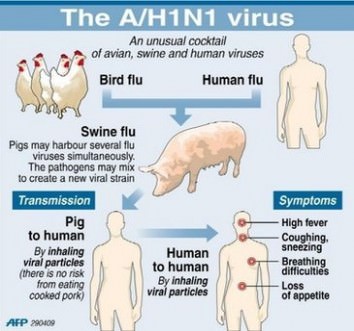 Therefore, the theory is simple: if the world didn’t eat as much pork, then there would be less demand to breed pigs in such large quantities, reducing the number of “mixing vessels”, thus slowing the rate of emergence of new influenza viruses capable of harming human health. (This is where the “we told you so” dance is more justified).
How does H1N1 influenza virus spread?
Spread of H1N1 influenza virus also called H1N1 flu virus from person to person occurs in the same way as seasonal flu, which is mainly spread person to person through coughing or sneezing by people infected with the influenza virus. People may become infected by touching something with flu viruses or germs on it and then touching their mouth or nose. Germs on hard surfaces, such as counters and doorknobs, can be picked up on hands and spread to the respiratory system when people touch their mouth or nose. It is important to wash your hands frequently.
Incubation period
The imcubation period is the time between the moment a person is infected with the H1N1 virus and the time they start showing symptoms. People in the incubation period appear healthy, but they can sometimes pass the virus on to others.
Right now, the incubation period of H1N1 appears to be somewhere between one and seven days. It is likely most infected people start having symptoms within four days.
Infectious period
The infectious period is the time when a person with H1N1 is contagious, which means they can pass the virus on to others. The infectious period for H1N1 is not yet completely known. The US CDC considers it to:
- Start one day before the person shows symptoms (gets sick)
- Last for seven days after the symptoms appear
If infected people are still sick after seven days, they should be considered potentially contagious until their symptoms have disappeared. Children may be contagious for longer, up to 10 days.
H1N1 flu vaccine
There is no specific vaccine against the new A/H1N1 virus. However work is underway by several manufacturers to develop a safe and effective vaccine. It may be ready by October 2009.
In June, the vaccine-manufacturing company Novartis announced they had successfully produced the first batch of experimental H1N1 vaccine. It will undergo lab testing, and if all goes according to plan, should be ready for human testing by July. Should human tests prove satisfactory, the vaccine may be ready for licensing application by the northern hemisphere fall. However, whether experts will recommend vaccination for the general public is a matter that is yet to be decided.
Seasonal influenza vaccine
Seasonal flu vaccines are those offered to the public every year as flu season approaches. They are designed to help prevent people during the upcoming, seasonal waves of flu activity.
Generally, most people should get a flu shot every year as a good health practice. In the current situation, it is still recommended that people who have not had an annual flu vaccination should consider having one to prevent regular seasonal flu.
It is unknown whether the current seasonal flu vaccine provides any protection against the strain of H1N1 flu currently circulating. Most likely, it is not effective against the new virus.
Many of the people who have gotten H1N1 flu in the USA had not had a seasonal flu vaccine. However, at least one case had been vaccinated, in October 2008. He got sick with H1N1 flu in early April, had a mild illness and recovered.
Other vaccinations
As a general good health practice, people should ensure their routine vaccinations are up-to-date. This includes pneumocococcal vaccination for certain adults: those over 65, people with serious long term health conditions and people whose immune systems are compromised due to transplants, cancer treatments, HIV/AIDS, etc.
FOR MORE INFORMATION- CLICK HERE
FOR MORE INFORMATION- CLICK HERE
Transferred from : http://muslimmatters.org
and http://www.internationalsos.com
and http://www.internationalsos.com

No comments:
Post a Comment